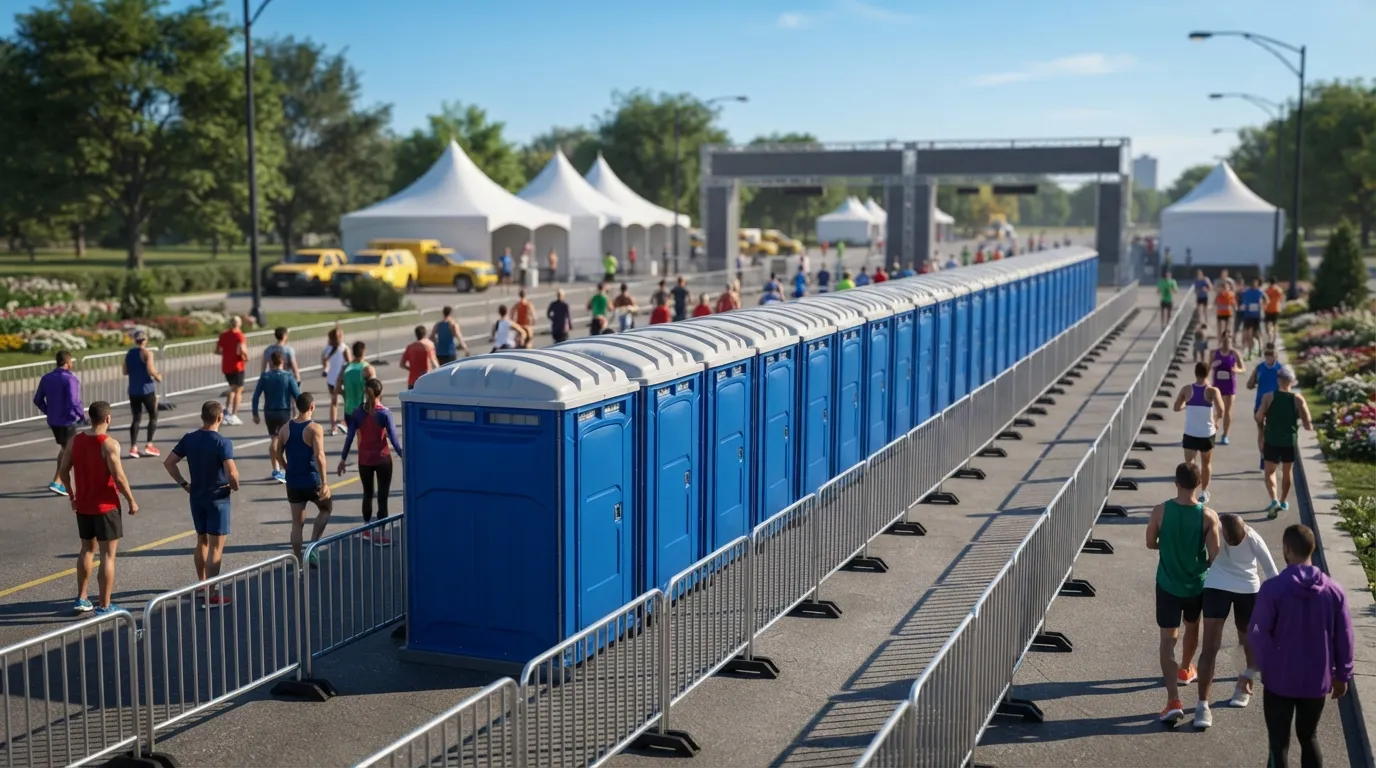
A typical marathon or road race in Providence needs one portable restroom per roughly 100 runners at the start line, plus extras staged near aid stations along the course. For a 2,000 runner field, that puts you in the 20-unit range before you even count spectators. Providence Porta Pros builds the layout around your course map, not a guess.
Start with the crowd, not the miles. Race organizers usually plan restrooms around runner count at the start and finish, since that is where everyone bottlenecks before the gun goes off. A field under 500 might run fine on standard portable toilets alone, split between the corral and the finish chute. Bigger fields change the math fast: once you're staging aid stations every couple of miles, each one needs its own small cluster, not just a unit or two borrowed from the start line. Providence Porta Pros lays out unit counts using the same logic OSHA applies to fixed jobsites under OSHA 1926.51(c), which sets ratios by headcount even though races aren't construction sites. It's a useful benchmark for spacing, not a rule that governs your event, but organizers who ignore it tend to get lines that back onto the course. For accessible running events or wheelchair divisions, ADA Standards section 213.2 calls for at least 5 percent of a clustered bank to be accessible, never fewer than one unit, so a finish line with 15 standard toilets needs at least one ADA unit in that group. We also stage handwashing stations at food and hydration points, since runners handling gels and cups near a first aid tent is a different sanitation problem than a construction crew. Course logistics matter as much as unit count: our trucks need about 60 feet of straight clearance for anything delivered as a roll-off dumpster for course cleanup, so drop zones get planned before race morning, not during it.
Timing mats, PA systems and finish-line video boards all draw power, and most race routes don't have an outlet within a mile of the corral. We run temporary power poles to timing tents and command posts, and how you brace a temporary power pole matters more than most organizers expect: the pole has to stand through wind gusts and a jostling crowd without a guy-wire tripping a runner. We set base plates on stable ground per ADA Standards section 302.1, which requires floor and ground surfaces to be firm and slip resistant, and that same stability standard is why we won't drop a pole or a restroom unit on soft turf without decking. Pair the pole with a light tower for pre-dawn setup crews, since most Providence road races start staging equipment before sunrise. If your finish line runs into evening, like a night race or a festival-adjacent event, lighting isn't optional, it's how volunteers find the restroom bank at all. We also fence off generator and power zones with temporary fencing so spectators and kids don't wander into cable runs. For events layering in a beer garden or VIP section, crowd control barrier rental keeps foot traffic separated from the power and restroom cluster without turning the finish area into a maze.
Restrooms belong at the start, the finish, and every aid station, never squeezed into a single cluster a half mile from where runners actually need them. Providence sees races that start downtown and finish near the water, and each of those zones needs its own bank of units rather than one oversized cluster at a single point. We've built race layouts for routes stretching toward North Providence, 4.2 miles northwest, and East Providence, 4.8 miles southeast, so course logistics spanning city lines aren't new to us. A restroom trailer works well at the finish line for staff, sponsors or a VIP tent, since it offers more than a single stall and holds up better under heavy short-term use than a bank of standard units. For multi-day events like a marathon weekend with an expo, monthly rental terms rarely apply, but weekend pricing does, and organizers should budget for delivery and pickup as separate line items, not folded into the unit price. Placement also has to account for ADA Standards section 405.2, which limits ramp slope to 1:12 for any accessible unit set on a curb or uneven sidewalk, common near Providence's older downtown blocks. Talk through your course map with us before you request a quote, because aid station spacing changes the count more than total runners do.
Book as soon as your course map and runner estimate are final, ideally 60 to 90 days out for a large field. Race weekends compete with weddings and festivals for the same trailers and standard units, so waiting until the month before limits what's available.
Not every aid station, but your start and finish clusters do need at least one accessible unit per ADA Standards section 213.2. Smaller aid stations with only two or three units still benefit from one accessible unit if runners with mobility needs are registered.
Yes, we schedule mid-event servicing for start and finish clusters that see heavy use over several hours. Aid station units along the route are typically serviced before and after the race rather than during it.
A 2 stall restroom trailer handles smaller races and staff use well, while larger finish festivals often need a 4 stall or 8 stall trailer. Pick based on finish-line dwell time, not just runner count.
Placement in the public right of way needs confirming with the city before race day. Check with your event permit coordinator alongside our porta potty permit requirements page so street closures and unit placement get approved together.
Yes. Providence Porta Pros delivers marathon and race restrooms across Providence and the surrounding metro, with same-day and next-day drop-off available on most orders.
Pricing depends on the unit and how long you need it. See our cost breakdown and request a free quote for an exact figure.
Standard rentals include scheduled service — a pump-out, a clean, a restock and fresh deodorizer. Busy or hot-weather sites can be serviced more often.
Call now or request a free quote — clean units, on-time delivery, transparent pricing.